
The War on Fed
Second-order effects


In the recently released weekly report for our blog subscribers, we posit that the Fed finds itself in a challenging situation.
On one hand, AI is destroying human jobs at a high rate, which is bound to increase in the near future.
On the other hand, the war in the Middle East is pushing energy prices higher, and the odds of rising inflation are increasing, which complicates the Fed’s ability to manage economic stability and its dual mandate effectively.
A wrong policy move could trigger a recession or even stagflation. The optimum action for the Fed on the rate front is to do nothing and let the government deal with the economic situation. Nevertheless, even doing nothing poses risks, since government actions could complicate policy in the future, especially if it includes some form of stimulus that may lead to inflationary pressures or misallocation of resources. What the Fed must avoid is a return to quantitative easing because this time the risks of runaway inflation are real.
The market reflects reality better than narratives. Year to date, the commodities DBC ETF is up 23%, and gold is gaining 19.5%. Note that the DBC ETF has a high correlation with crude oil.
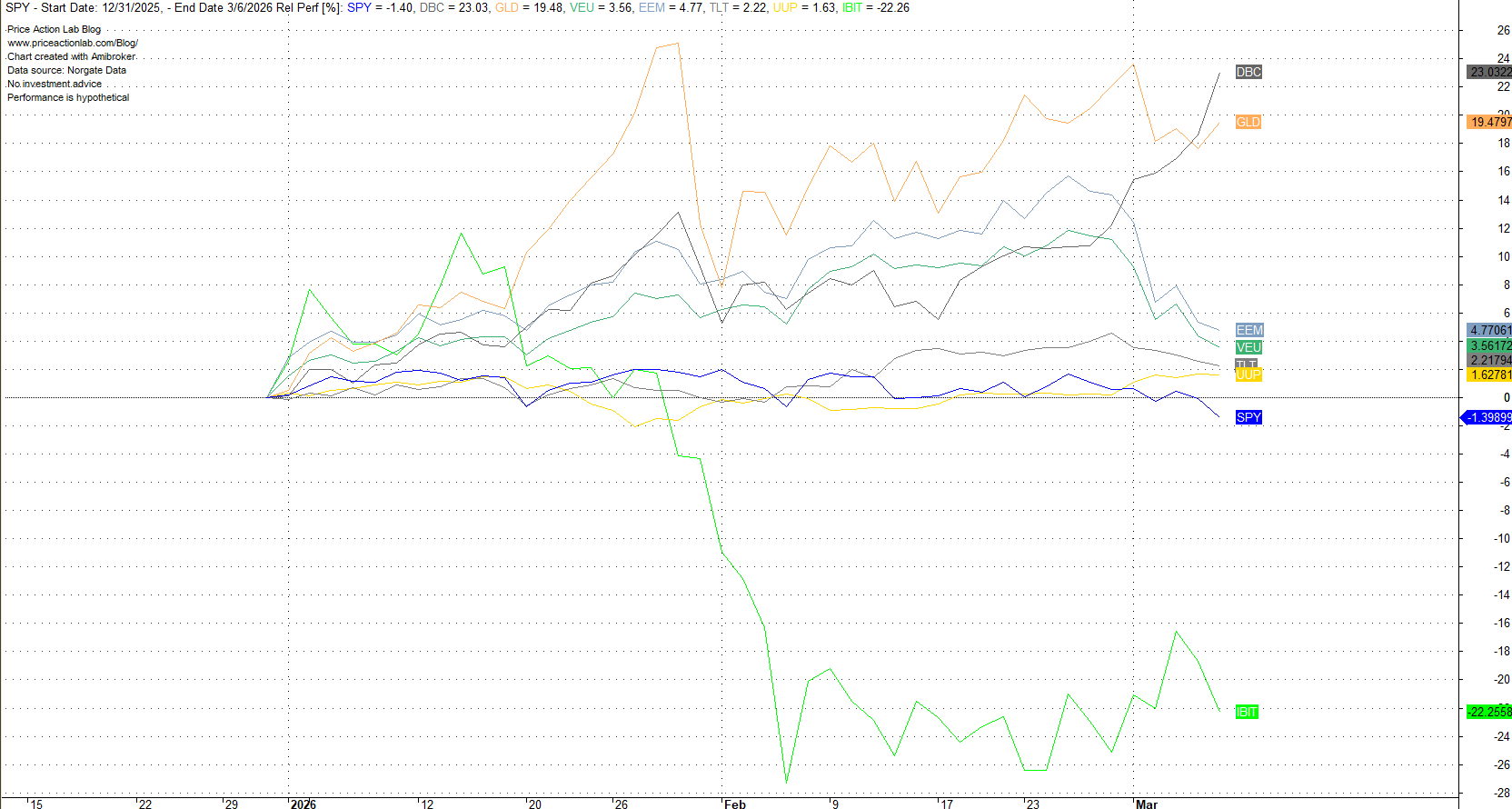
On the other hand, large caps (SPY) are down 1.5%, and Bitcoin, the digital asset (IBIT), is down 22.3%.
Many equity analysts tend to overlook these facts, assuming that the market is continuing its usual operations. A new market regime change could be in progress, but it is too early to speculate about its potential impacts on market dynamics and investor behavior.
We believe that the sell-off in value and quality factors this week was alarming, especially the former, because investors usually find rescue in value during the first stages of a bear market. So, as it seems, we may be past the first stages now. We will find out soon, because all forecasts have low statistical significance when we deal with new market regimes, making it difficult to predict how the market will behave.
As we noted in our weekly report, the big risk for the stock market is investors deciding that cash is the best hedge at this point, which could lead to a significant sell-off in equities as they move to preserve capital in uncertain market conditions.