
Premabulls Disappear During Corrections
You are alone


Do you know what the permabulls with those social media accounts and podcasts who consistently edit, refresh, and publish the same articles about the advantages of buying and holding, or even dollar-cost averaging, will do when the next bear market arrives? They will disappear for a while!
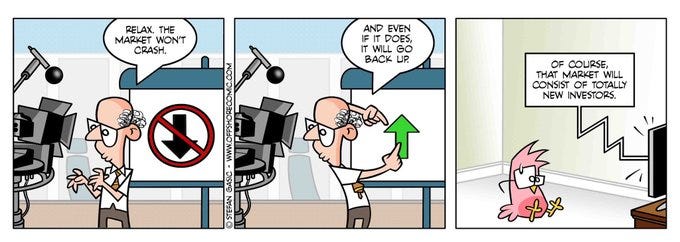
This is their routine, and once the markets recover, they resurface, boasting about their long-term track record and the advantages of averaging down, often accompanied by graphs. The audience will mostly consist of “new investors,” because most of the older ones exit when the panic starts.
Events such as the global financial crisis (2008), the dot-com crash (2000), the COVID-19 market crash (2020), and the inflation pain trade (2022) provide sobering lessons about the destructive power of the market.
Although no one can predict when the next downturn in equity markets will occur and how destructive it will be, protecting investment portfolios requires understanding the risks and taking the necessary steps to mitigate potential losses.
Bear markets are inevitable and usually involve sharp and quick drops. Due to speculative excesses in technology stocks, the NASDAQ fell more than 70% from its peak between 2000 and 2002 during the dot-com crash. A housing bubble led to the 2008 financial crisis, which destroyed roughly half of the value of the world’s equity markets. The COVID-19 pandemic caused the 2020 crash, which saw the S&P 500 fall 35% in less than a month. During a bear market, investors panic and sell. Leveraged investors can even face liquidation and devastating losses.
Large corrections have historically followed periods of euphoria. Despite persistent high bond yields and unprecedented geopolitical uncertainty, investors have increased risks. Technology stocks and speculative investments in artificial intelligence could trigger the next domino effect and broad market selling.
The most robust indicator of rising risks
The number of articles and social media posts about the merits of passive stock index investing near all-time highs has always served as a robust indicator of stress accumulation in the markets. The authors of these articles likely haven't experienced the pain of losing 30% or 50% of hard-earned money and the panic that accompanies these losses. These analysts claim that all investors should simply remain in the market and even increase their risk after reaching new, all-time highs, as backtests indicate that the likelihood of losing is low. These naive claims disregard the psychology of investors and the reality of situations where they can no longer afford to remain invested. Simultaneously, while markets reach new all-time highs and excessive optimism prevails, some astute investors are selling their positions, and fund managers must attract new capital to sustain their fee revenue. The result is that we see many more articles written by fund managers near all-time highs predicting a continuation of the uptrend than we see during market bottoms when the opportunity for profits is high.
There will be no warning
A wrong geopolitical decision or some adverse financial development could trigger panic selling and massive losses. Stocks could crash, but other assets could gain, including precious metals. Gold has been the best-performing asset by a significant margin since 2022, and this trend is not accidental: some investors have chosen to diversify to mitigate their risks. Diversification and market timing can reduce losses but often come at a cost.
While the timing of the next bear market or crash remains uncertain, history demonstrates the importance of preparedness. Although the dot-com bust, the 2008 financial crisis, the 2020 market crash, and the 2022 inflation pain trade each had different causes, they all shared two common factors: excessive speculation and systemic weaknesses. You can set up your portfolio to withstand a possible downturn and take advantage of the opportunities that arise by taking a diversified, disciplined approach.
The furu trap
Avoiding the furu trap is the first step to successful trading and investing. Even simple systematic strategies have generated respectable risk-adjusted returns over the years and do not require trying to predict the market direction. Strategies provide well-defined entry and exit signals, which is something that a furu rarely does. Usually, furus produce many different articles with various market forecasts, some even contradictory, and after major market moves, they point to the ones that are in agreement. Sophisticated marketing deceives many investors and traders, making them their victims.
DISCLAIMER
None of the information contained in this email constitutes a recommendation that any particular security, portfolio of securities, transaction, or investment strategy is suitable for any specific person. You understand that the Author is not a financial adviser, and that the Author is not advising, and will not advise you personally concerning the nature, potential, value, or suitability of any particular security, portfolio of securities, transaction, investment strategy, or other matter. To the extent any of the information contained in this email may be deemed to be investment advice, such information is impersonal and not tailored to the investment needs of any specific person.
Hello Sir! Thank you so much for your wonderful articles and posts.
I've been able to avoid major declines so far by focusing on following particularly talented investors and analysts, including you.
I especially prepare myself when your voices of warning grow louder and more frequent.
For example, precious metals investors (gold bugs) are very optimistic, and they only look at the precious metals market and not the overall picture.
During the recent major crash, judging from their posts at the time, it seemed that 90% of them thought the market would continue to rise.
That's why I focus on following wise people like you who look at the overall picture and have extensive investing experience.
Precious metals investors are still too optimistic, and very few people are pointing out that precious metals will also be sold off heavily if a major deleveraging occurs.
Currently, precious metals are rising due to the risk of war, but if the situation worsens further and leads to stock deleveraging, I believe there is still a risk of precious metals being sold off heavily, so I try not to hold too many positions.
Once again, thank you for your advice!